
A Digital Operations Review examines how a business’s website, content, forms, tools, reporting, and follow-up process work as one operating system. The purpose is not to produce a long inventory of software or a generic marketing score. It is to find the handoff that creates the most confusion, delay, risk, or wasted effort—and determine the smallest responsible fix.
For a small business, that distinction matters. A website can look polished while inquiries still reach the wrong inbox. Analytics can be installed while nobody measures the actions that matter. A team can own several powerful tools and still rebuild the same information by hand every week.
A useful review follows the work from the customer’s first action to the business outcome. It documents what happens, identifies who owns each step, tests the evidence, and produces a prioritized action path.
A Digital Operations Review Follows the Work, Not the Tool List
Most digital problems cross system boundaries.
A prospective customer may find a service page through search, read an article, submit a form, trigger an email notification, enter a shared mailbox, receive a reply, and eventually become an active project. No single platform owns that entire path.
That is why a review organized only as “website, social media, CRM, and analytics” can miss the real failure. Each tool may appear to work on its own. The break often sits between them:
- the page does not set expectations before the form;
- the form omits information needed for a useful response;
- the notification reaches a mailbox nobody owns;
- the lead is copied into a tracker without a next action;
- the conversion is not measured;
- or the process depends on one person remembering what happens next.
The OECD’s review of digital business diagnostic tools for small and medium-sized businesses describes diagnostics as a way to identify strengths and weaknesses and connect them to appropriate guidance. At the scale of one small business, the same principle applies: diagnose the operating gap before selecting a new product or project.
The Five Layers of a Useful Review
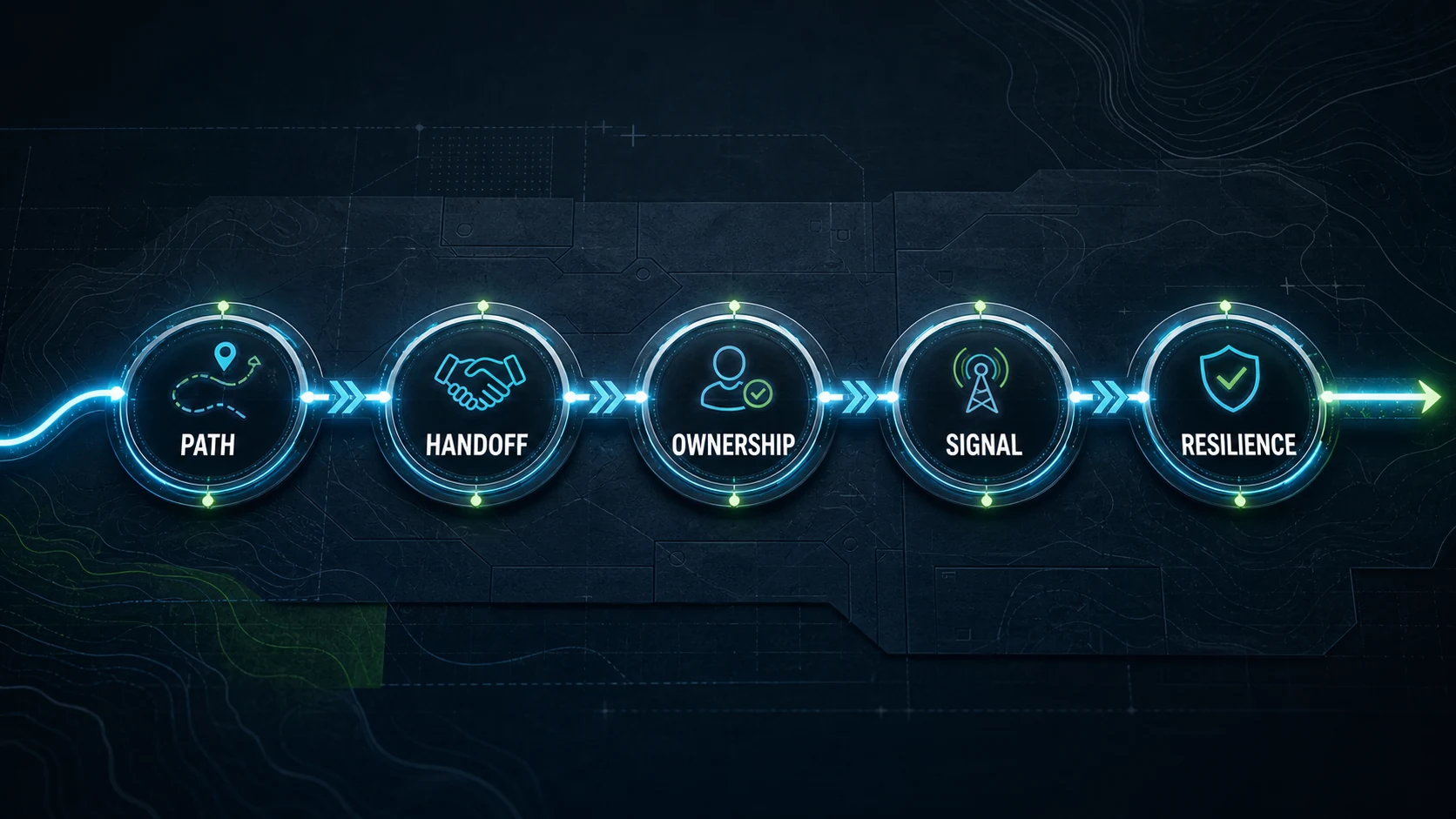
Dark Monkey Media’s review framework can be understood through five connected layers: Path, Handoff, Ownership, Signal, and Resilience.
1. Path: can a person complete the intended journey?
The first layer follows a real task from beginning to end.
Examples include:
- finding the right service;
- understanding whether the business is a fit;
- requesting an estimate;
- subscribing or making a purchase;
- locating proof of past work;
- or getting an answer to a common question.
The reviewer checks the pages, calls to action, navigation, mobile experience, forms, confirmations, and follow-up expectations involved in that task. The question is not whether every page looks finished. It is whether a visitor can move forward without unnecessary uncertainty.
Evidence may include live page reviews, mobile screenshots, form-field inventories, broken-link checks, page-speed observations, search snippets, and test submissions.
2. Handoff: does the information reach the next step intact?
Every important customer action creates a handoff.
A form submission may become an email. An email may become a task. A completed project may become a case study, photo library, invoice, or follow-up sequence. A published article may become a search landing page and a source for future social content.
The review documents:
- what information enters the process;
- where it goes;
- whether anything is copied manually;
- what conditions change the route;
- how exceptions are handled; and
- how the next person knows action is required.
This is often where a small correction has more value than a large rebuild. A clearer form, routing rule, shared status field, or documented checklist can remove more friction than another subscription.
3. Ownership: does a person own the result?
Software can run a workflow, but it cannot accept accountability for the business outcome.
For each important path, the review identifies:
- who approves the process;
- who receives the work;
- who maintains the information;
- who handles exceptions;
- who verifies that an automation ran;
- and who decides when the process needs to change.
This layer also checks account ownership and access. Business-critical websites, analytics properties, domains, mailboxes, and automation connections should not depend on an unknown login or a former contractor’s personal account.
The NIST Cybersecurity Framework 2.0 resources for small businesses frame cybersecurity as a risk-management responsibility, not merely a technical product. A digital review is not a full security assessment, but it should flag obvious ownership, access, backup, and recovery gaps for qualified follow-up.
4. Signal: can the business tell whether the path worked?
Reporting should help someone make a decision.
Page views can provide context, but the stronger signals are actions tied to the business: a qualified inquiry, appointment request, purchase, download, phone call, or completed application. Google Analytics defines a key event as an action that is particularly important to the business and makes those events available in reporting.
A review checks whether:
- the important action is defined;
- the site or system can record it;
- test activity appears correctly;
- the report reaches an owner;
- and the result changes a decision.
If nobody knows what would count as success, installing another dashboard will not solve the problem.
5. Resilience: can the system survive ordinary change?
Small-business systems change constantly. A staff member leaves. A password expires. A form plugin updates. A mailbox is renamed. A campaign ends. A service changes.
The review looks for:
- documented settings and decision logic;
- backups and recovery ownership;
- multifactor authentication and sensible account access;
- update and maintenance responsibility;
- failure notifications;
- manual fallback steps;
- and the ability to test the path after a change.
CISA’s small and medium-sized business resources emphasize practical controls including multifactor authentication, software updates, logging, backups, and data protection. Those controls belong in the operational conversation because a workflow is not dependable if the business cannot maintain or recover it.
What Evidence Should the Reviewer Examine?
A credible review is evidence-based. Interviews are useful, but memory alone is not enough.
The evidence set should be proportional to the business and may include:
- public website pages and search-result previews;
- navigation, service paths, forms, and confirmation messages;
- WordPress or platform configuration relevant to those paths;
- analytics events and recent reports;
- email and task-routing logic;
- content calendars, asset libraries, and approval steps;
- automation diagrams, run histories, and error notifications;
- domain, account, role, and access ownership;
- maintenance records, backups, and recovery procedures;
- and a small number of end-to-end test transactions.
Sensitive access should be limited to what is necessary. A reviewer should explain what will be inspected, what will not be retained, and which findings require a specialist rather than overstating the scope.
An Internal Field Note: The Contact Form Was Not the Whole System
During Dark Monkey Media’s own website buildout, the public email presentation, WordPress contact-form notification, WordPress administrative setting, and Microsoft 365 routing destination had to be treated as one path.
The form used WordPress’s {admin_email} value for notifications. The business also needed public inquiries to reach the correct Microsoft 365 sales route without exposing an internal administrative address on public pages.
The fix did not require a new form platform. It required mapping and testing the handoff:
- Set the correct public-facing email on the Contact and Privacy pages.
- Confirm the WordPress administrative email used by the form notification.
- Verify the Microsoft 365 destination behind that address.
- Submit the public form.
- Confirm both the visitor-facing success message and actual mailbox receipt.
That is a compact example of digital operations work. The visible page, hidden configuration, delivery route, and acceptance test all mattered. Checking only the form design would have left most of the system unexamined.
What Should the Business Receive?
A Digital Operations Review should end with decisions, not a pile of observations.
The final package should include:
A current-state map
A concise view of the important customer paths, systems, handoffs, owners, and measurement points. The map should be understandable without reopening every tool.
Evidence-backed findings
Each finding should name the observed condition, supporting evidence, likely consequence, and affected path. “Improve the website” is not a finding. “The service page sends every visitor to a general form that omits the requested service and project timing” is.
Prioritized recommendations
Recommendations should be ordered by business impact, risk, effort, dependency, and confidence. The first action is not always the largest project. It is often the correction that makes later work possible.
A 30-, 60-, or 90-day action path
The plan should distinguish:
- quick corrections;
- foundational documentation;
- measurement work;
- larger builds or migrations;
- and items that should wait.
Each priority needs an owner and an acceptance test.
Clear boundaries
The review should identify what was not tested, which assumptions remain, and when legal, accessibility, cybersecurity, accounting, or another specialist review is appropriate.
What a Digital Operations Review Is Not
A review is not automatically:
- a full cybersecurity audit;
- a legal or accessibility certification;
- an excuse to replace every tool;
- a promise of rankings or revenue;
- a generic marketing plan;
- or a backlog containing every possible improvement.
It is also not the right first step when the business cannot name a current offer, owner, or customer path. In that case, basic business and process clarification may need to happen before a systems review can produce useful priorities.
How to Decide What Gets Fixed First
A practical prioritization method asks five questions:
- Impact: What customer or business outcome is affected?
- Frequency: How often does the failure or manual task occur?
- Risk: What happens if it is missed, delayed, or exposed?
- Dependency: Does another improvement require this one first?
- Effort: What is the smallest change that can be tested responsibly?
This prevents two common mistakes: starting with the most visible problem because it is easy to discuss, or starting with the largest project because it feels strategic.
The review should create an order of operations. Clarify the path. Repair the handoff. Assign ownership. Measure the result. Then automate or expand where the evidence supports it.
The Bottom Line
A Digital Operations Review is useful when a business has digital activity but lacks a dependable operating picture. It connects the customer path to the internal handoff, identifies ownership, checks measurement, and tests whether the system can be maintained.
You should leave the review knowing what is broken, what evidence supports that conclusion, what to fix first, who owns the result, and how the business will know the change worked.
Dark Monkey Media applies this systems-first approach across digital operations and automation services and demonstrates it through owned brands built as working systems. If your website, forms, content, reporting, and follow-up still feel disconnected, you can request a Digital Operations Review to identify the first break worth fixing.