
You probably do not need another app.
You may need a digital operations improvement when the same handoff keeps failing: a website inquiry arrives without enough context, a team member copies information between systems, a useful photo cannot be found when it is needed, or a weekly report is produced but never changes a decision.
The practical answer is this: invest when recurring friction has a meaningful cost, the underlying process is stable enough to improve, one person can own the change, and success can be measured. If those conditions are missing, document the process before you automate or rebuild it.
Digital Operations Is Really About the Handoffs
Small businesses often describe digital operations as a list of tools: WordPress, Microsoft 365, a CRM, analytics, social platforms, automation software, and AI assistants.
The tool list is not the operating system. The handoffs are.
A website form must send useful information to the right person. A new lead must move from inquiry to response without relying on memory. A completed project should produce proof that can be used on the website and in future content. Reporting should tell the owner what deserves attention instead of creating another spreadsheet to maintain.
That is why adding software can make a weak process worse. A new platform may move the same confusion into a more expensive interface.
The OECD’s review of digital business diagnostic tools for small and medium-sized businesses describes diagnosis as a way to help owners recognize performance gaps and connect those gaps to appropriate guidance. The same principle works at a smaller scale: identify the break before choosing the fix.
If the problem still feels broader than one broken workflow, start with what a Digital Operations Review examines before comparing solutions.
Use This Four-Part Test Before You Invest
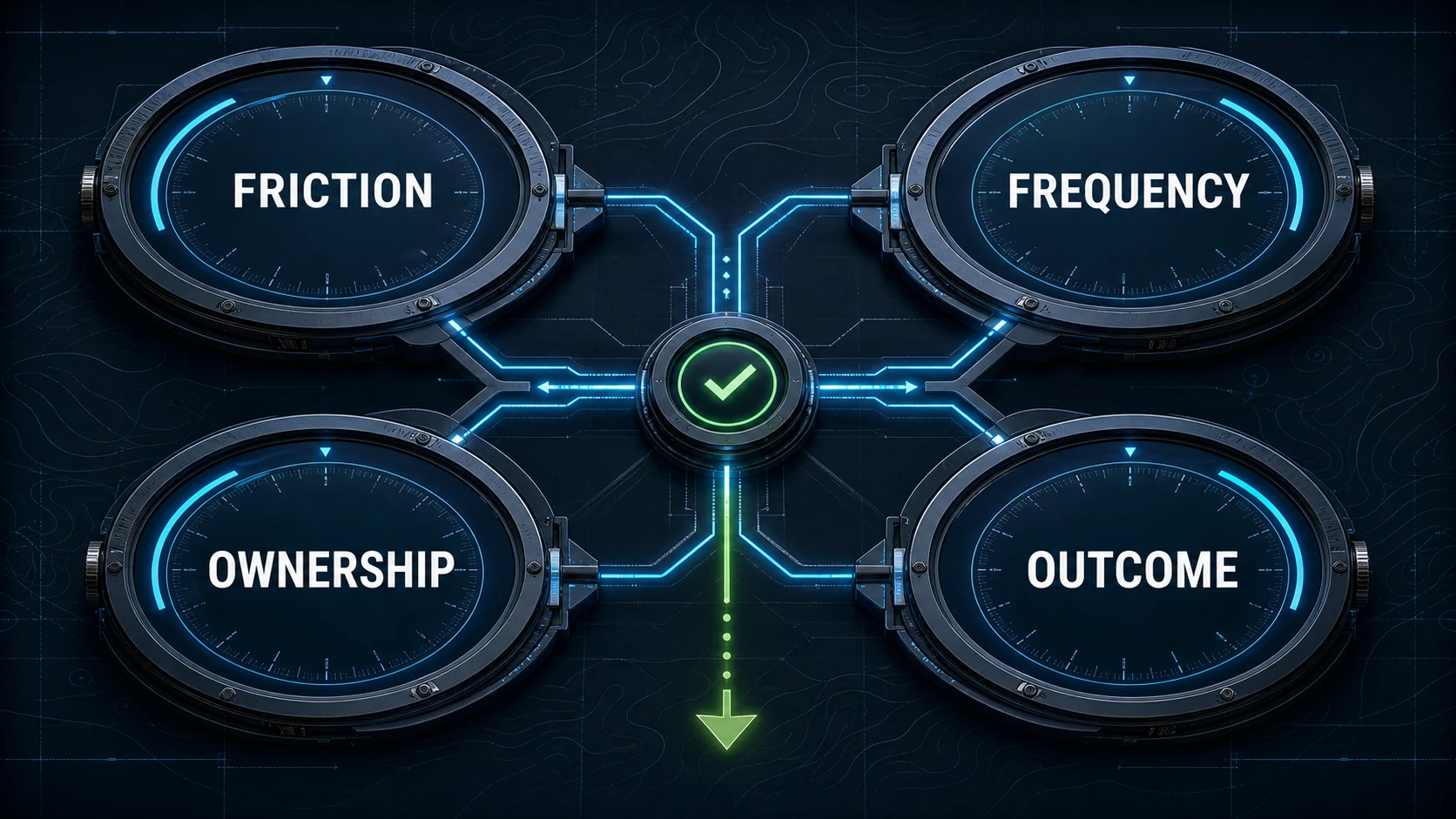
Evaluate the problem through four questions: friction, frequency, ownership, and outcome.
1. Friction: what is actually going wrong?
Describe the failure without naming a product.
Weak diagnosis:
We need a CRM.
Useful diagnosis:
New inquiries arrive through email and the website, but no single view shows the contact, requested service, budget, last response, or next action.
The second version exposes the information and handoff problem. A CRM might help, but so might a better form, a shared list, a routing rule, or a defined follow-up process.
2. Frequency: how often does it happen?
A frustrating task is not automatically an investment priority. Count it.
Track the problem for a normal month:
- How many times does the task occur?
- How many minutes does each occurrence require?
- How often does information need to be corrected or recovered?
- How many people touch the process?
- What happens when the task is delayed or missed?
A process that consumes ten minutes twice a year probably does not need automation. A process that consumes ten minutes twenty times a week deserves a closer look.
3. Ownership: who is responsible for the result?
Tools do not own outcomes. People do.
Before investing, identify who will:
- approve the process;
- maintain the information;
- handle exceptions;
- check whether the workflow ran;
- review the measurement; and
- decide what changes next.
If nobody owns the handoff, a new tool usually creates another unattended inbox, dashboard, or queue.
4. Outcome: what should improve?
Define one observable result before work begins.
Examples include:
- every website inquiry reaches the sales mailbox with the required context;
- the owner can see which inquiries still need a response;
- approved images can be found by project and usage right;
- a monthly report identifies the pages or campaigns that need action;
- a content request moves from idea to approval without being recreated in multiple documents.
Avoid goals such as “be more efficient” or “use AI.” They are directions, not acceptance criteria.
Estimate the Monthly Cost of Friction
You do not need a complex business case to compare a small workflow problem with a potential fix.
Start with:
Monthly time cost =
occurrences per month × minutes per occurrence ÷ 60 × hourly value of the people involved
Then add costs that time alone misses:
- delayed responses;
- duplicate work;
- correction or rework;
- missed inquiries;
- inconsistent customer experience;
- data or access risk; and
- decisions made without reliable information.
Consider a hypothetical service business that handles 15 website inquiries per month. If someone spends 12 minutes per inquiry reconstructing missing details and copying them into a tracker, that is three hours of work. At an internal time value of $45 per hour, the visible cost is $135 per month before counting missed follow-up or rework.
That calculation does not automatically justify a large CRM project. It gives the owner a boundary. A small form and routing correction may have a short payback. A complex migration may not.
When You Should Not Invest Yet
Digital operations work is premature when:
- the task is rare and inexpensive to perform manually;
- the service, offer, or process changes every week;
- the team cannot agree on what information is required;
- nobody can own the result after launch;
- the proposed tool introduces more maintenance than it removes;
- the problem has been noticed once but not measured; or
- a clearer instruction, form field, email rule, or page rewrite would solve it.
Automation is especially risky when the current process is undocumented. You may automate a mistake, hide an exception, or make a fragile workaround run faster.
The right sequence is usually: clarify, simplify, test, then automate.
An Internal Example: Fixing the Contact Handoff
Dark Monkey Media encountered a small but useful digital operations problem during its own 2026 website buildout.
The public Contact and Privacy pages exposed an internal administrative address. The WordPress contact form used the {admin_email} merge value for notifications, while the business needed public inquiries to reach its Microsoft 365 sales route.
This was not a reason to buy a new form platform or replace the website. It was a handoff problem across several existing controls:
- the public email displayed on the site;
- the WordPress administrative email setting;
- the WPForms notification dependency;
- the Microsoft 365 routing destination; and
- the end-to-end confirmation that a submitted form reached the intended mailbox.
The fix separated the public address from the internal configuration address, updated the WordPress routing value, preserved the form’s merge-field behavior, and tested the complete path from public submission to confirmed receipt.
The lesson is not that every business should use the same tools. The lesson is that a digital operations improvement should trace the entire handoff. Editing only the visible email address would have left the notification path unresolved. Changing only the form would have left the public pages inconsistent.
Fix the Smallest Control That Resolves the Handoff
Once the four-part test supports an investment, work in this order:
- Write the current handoff from trigger to completed result.
- Mark where information is missing, duplicated, delayed, or dependent on memory.
- Count the frequency and estimate the monthly cost or risk.
- Choose the smallest change that can remove the priority break.
- Test the full path, including exceptions and notifications.
- Assign an owner and document the control.
- Measure the agreed outcome after the change.
This sequence may lead to a page rewrite, a better intake form, a shared tracker, a routing rule, an automation, or a platform change. The diagnosis should choose the tool—not the other way around.
The Decision Rule
Invest in digital operations when all four conditions are present:
| Condition | Ready when |
|---|---|
| Friction | The failure is specific and affects a real business handoff |
| Frequency | The problem repeats often enough to create meaningful time, cost, or risk |
| Ownership | One person can approve, maintain, and review the improved process |
| Outcome | Success can be observed or measured after the change |
If one condition is missing, the next step is usually documentation or a small test. If all four are present, the business has enough clarity to compare the cost of the problem with the cost of a fix.
That is the moment digital operations stops being a vague improvement project and becomes a practical business decision.
If you can see the recurring friction but have not isolated the broken handoff, request a Digital Operations Review to map the current process and identify the first control worth fixing.