
A simple social media plan should make a local business easier to understand and easier to choose. It should not turn the owner into a full-time publisher.
The strongest plans begin with the customer path: someone notices the business, decides whether it fits their situation, looks for evidence, and takes a next step. Social media can support that path, but it cannot replace clear services, accurate business information, a useful website, or reliable follow-up.
The goal is not to fill a calendar. The goal is to publish a small amount of trustworthy material that answers real questions and points people somewhere useful.
Start With the Business Path
Before choosing post ideas, define one business priority for the next month.
Examples include:
- help customers understand a service that is regularly confused with another;
- prepare people for a seasonal deadline or change in availability;
- show the process behind work that is difficult to evaluate from the outside;
- improve the quality of inquiries for one service;
- or direct customers to an updated booking, request, or service page.
Then identify the customer action that would indicate progress. It might be a visit to a service page, a call, a booking, a qualified form submission, a store visit, or a useful direct-message conversation.
This keeps the plan anchored. A post can earn attention and still be a poor use of time if it attracts the wrong audience, makes the offer less clear, or has no sensible destination.
If the larger marketing workflow is still scattered, start with the seven-stage small-business marketing system. If the customer path crosses several disconnected tools or owners, a Digital Operations Review can expose the broken handoffs.
Give Each Channel a Job
A local business does not need to be equally active everywhere. Choose channels according to customer behavior, available evidence, and the team’s ability to maintain them.
Write one sentence for each active channel:
We use this channel to help this audience understand this part of the business and take this next step.
That sentence should be different for each channel.
For example:
- A Google Business Profile may carry timely local updates, offers, events, and direct links for people already searching for the business or its category.
- Instagram may be useful when original photographs, short demonstrations, visual progress, or place-based details help a customer evaluate the work.
- Facebook may support community updates, events, service-area information, and conversations with an established local audience.
- LinkedIn may make sense when the buyer is another business and the useful material concerns operations, expertise, hiring, or project decisions.
- Email may be the better home for information intended for existing customers rather than a public feed.
Google’s documentation explains that Business Profile posts can include updates, offers, events, media, and action links. That makes the profile an operational publishing surface, not merely a directory listing.
Do not keep a channel because it appears on a generic marketing checklist. Keep it because it has a defined audience, a maintainable role, and a path to something the business owns.
Use Four Durable Content Lanes
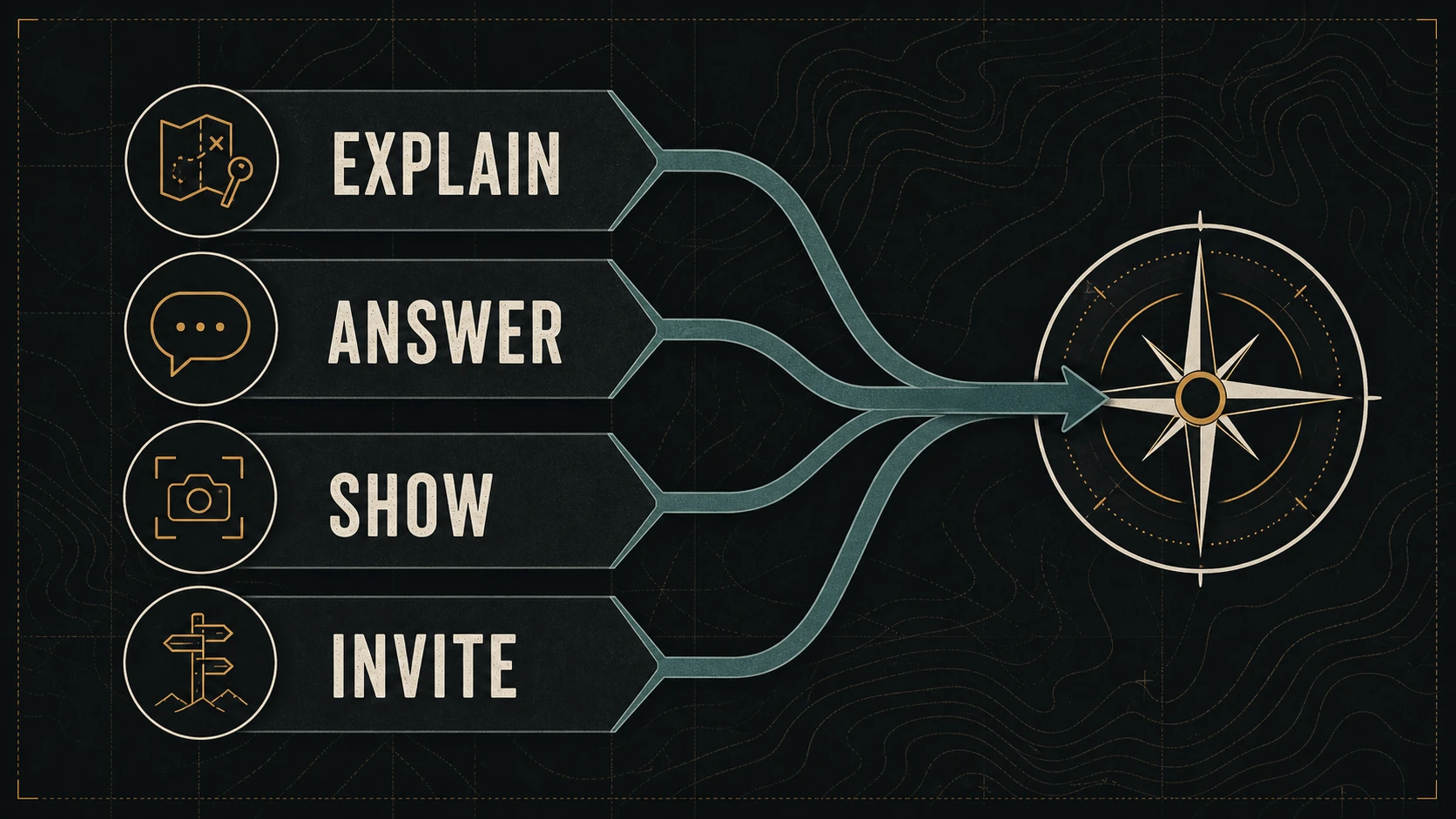
Trends change quickly. Customer uncertainty changes more slowly. Four practical content lanes can carry most of a local business plan without forcing the team to invent a new strategy every week.
Explain
Clarify what the business does, who a service is for, where it is available, how options differ, and what a customer should expect.
Useful subjects include:
- the difference between two commonly confused services;
- what is included and excluded;
- service-area or availability details;
- pricing factors without unsupported promises;
- and signs that a customer needs a different provider or specialist.
An explanation is successful when it helps the right person self-select.
Answer
Use questions heard in real calls, emails, appointments, comments, and sales conversations.
A strong answer does more than repeat the question in caption form. It gives enough context to help someone make a decision, then links to the page where the complete information belongs.
Keep a shared question log. Record the wording customers actually use, who can verify the answer, and whether the answer belongs on the website before it becomes a social post.
Show
Show the work, environment, preparation, materials, sequence, or quality controls that help a customer evaluate the business.
Think like a photographer building a useful field record. A wide frame establishes context. A detail frame shows workmanship or condition. A sequence explains change. A caption identifies what the viewer is seeing and why it matters.
“Behind the scenes” is not a strategy by itself. The image or video should prove something relevant: care, scale, process, readiness, limitation, or result. Obtain permission before showing identifiable customers, private property, sensitive information, or work governed by a contract.
Invite
Give the reader a proportionate next step.
The invitation may be to:
- read a service page;
- check availability;
- prepare information for an estimate;
- reserve a place at an event;
- call with a specific type of question;
- or save a useful reference.
Not every post needs a sales pitch. It does need a reason to exist. Sometimes the right next step is simply to understand the business better.
Build One Month From Real Material
Start with what the business can support, not an arbitrary frequency.
Choose one monthly priority and gather:
- three to five customer questions;
- one service or offer that needs clearer explanation;
- one set of original photographs or short clips;
- one proof item the business has permission to use;
- one useful website destination;
- and any dates, locations, exclusions, or compliance details that affect the message.
Then assign the material across the four lanes. A practical month might contain:
| Week | Primary subject | Lane | Evidence | Destination |
|---|---|---|---|---|
| 1 | Who the service is for | Explain | Approved service language | Service page |
| 2 | A frequent preparation question | Answer | Staff-verified response | FAQ or request page |
| 3 | One meaningful process detail | Show | Original photo sequence | Work or service page |
| 4 | Seasonal availability and next step | Invite | Confirmed schedule | Booking or contact page |
This is a planning example, not a rule that every business must publish weekly. One complete, verified post is more useful than four rushed posts built from guesses.
Create a Lightweight Publishing Workflow
Each post needs a visible path from idea to public result.
Capture
Store questions, photos, notes, dates, permissions, and relevant links in one shared location. Keep original image files rather than relying on compressed copies downloaded from a social platform.
Draft
Write for the chosen audience and channel. Lead with the useful point. Include the context needed to understand the claim. Use plain language and a next step that matches the post.
Google’s people-first content guidance is written for web search, but the editorial test carries well: create material for an existing audience, demonstrate real knowledge, and leave the reader with enough information to move forward.
Review
One accountable person should confirm:
- facts, dates, service areas, and offer terms;
- image and testimonial permissions;
- spelling of names and locations;
- links and tracking parameters;
- alt text or useful visual description;
- disclosure requirements;
- and who will respond after publication.
Schedule and Publish
Scheduling tools can reduce last-minute work, but they do not replace review. Facebook’s Help Center documents how Page posts can be scheduled and managed through Meta Business Suite, including moving a scheduled item back to drafts.
After publication, open the public post. Check the crop, caption, link, action button, location, and mobile presentation. A correct preview is not proof of a correct public result.
Respond
Assign comment and message ownership. Decide which questions can be answered publicly, which should move to a private channel, and which require an owner or specialist.
A social plan that creates conversations without a response process is incomplete.
Protect Trust, Access, and Permissions
Local businesses often work close to customers, homes, workplaces, vehicles, health information, or identifiable locations. Treat publishing permission as an operating requirement.
Maintain a basic record of:
- who created the asset;
- what it depicts;
- where it may be used;
- whether a person, customer, or property owner approved publication;
- whether an endorsement or testimonial is representative and supportable;
- and when the material should be reviewed or retired.
The Federal Trade Commission states that endorsements must be truthful and not misleading, and that a material connection that could affect how people evaluate an endorsement should be disclosed. Use the FTC’s endorsement and testimonial guidance when a post involves reviews, gifts, paid relationships, employees, partners, or creators.
Protect the accounts as carefully as the content. Use individual access, appropriate roles, multifactor authentication, and a documented owner. Do not make one shared password the continuity plan for the business.
Measure the Path, Not Applause
Choose one business-relevant action for the monthly priority. Then use a small number of diagnostic signals to understand the path.
Business signals may include:
- qualified calls or form submissions;
- booking or estimate requests;
- visits to the intended service page;
- offer redemptions using a documented method;
- or conversations that contain the target customer question.
Diagnostic signals may include:
- profile visits;
- link clicks;
- saves or shares on genuinely useful reference material;
- video completion where the sequence matters;
- direct-message topics;
- and recurring questions that show the explanation is still incomplete.
Do not treat reach as proof of revenue or engagement as proof of intent. Record what the platform can actually show, what the website can measure, and what the business learned in calls or appointments.
At the end of the month, make one decision:
- improve the explanation;
- reuse the evidence in another appropriate format;
- update the website destination;
- answer a newly visible question;
- change the channel;
- reduce the cadence;
- or stop a type of post that is not helping.
The review is valuable only when it changes the next plan.
A Worked Local-Service Example
Consider a hypothetical home-service company approaching a seasonal maintenance period.
Its priority is not “increase engagement.” It is to help property owners understand when maintenance is appropriate, what information an estimate requires, and how to request service before the schedule fills.
The month could include:
- An Explain post distinguishing routine maintenance from repair, linked to the service page.
- An Answer post listing the information a customer should gather before requesting an estimate.
- A Show post using an approved wide photograph and two details to explain one inspection step.
- An Invite post stating the confirmed service window, geographic limits, and correct booking path.
The business captures the photos and technician notes in one visit. An owner verifies the claims and schedule. The publisher adapts the approved material to the chosen channels, checks the public posts, and records which questions appear in the resulting inquiries.
That is a system. It is small enough to run and specific enough to improve.
What to Stop Doing
A cleaner plan often begins by removing work:
- Stop publishing filler because a calendar cell is empty.
- Stop copying the same caption into every channel without considering context.
- Stop using stock imagery when the visual implies real local work.
- Stop posting an offer before its dates, terms, destination, and response owner are confirmed.
- Stop chasing trends that do not help customers understand the business.
- Stop measuring only the signals that platforms make easiest to see.
Consistency is not constant output. It is the ability to make and publish useful material without losing accuracy, ownership, or the thread back to the business.
The Bottom Line
A useful local-business social media plan connects one business priority to real customer questions, credible evidence, a small set of channel roles, a workable publishing process, and a measurable next action.
Begin with one month. Use the four lanes—Explain, Answer, Show, and Invite—to organize material the business can verify. Publish at a pace the team can review and support. Then use the result to make the next month more informed.
Dark Monkey Media helps businesses build practical content systems and digital operations when scattered files, unclear ownership, or disconnected publishing tools are getting in the way. If you already know where the process breaks, start a focused conversation about the smallest useful fix.